HCI-SI 2026 – Final Conference Programme

The programme is now finalised. We look forward to seeing you at the 11th Human-Computer Interaction Slovenia 2026 conference.

Tuesday, 17 November 2026 | Jožef Stefan Institute, Teslova ulica 30, Ljubljana

Map: https://maps.app.goo.gl/Dwb4T84fS5SZReYx9

Registration is open. Register for HCI SI 2026 here.

TIMEPROGRAMME
08:30–09:00Registration and welcome coffee
09:00–09:15Opening remarks: Sašo Džeroski, Head of the Department of Knowledge Technologies, Jožef Stefan Institute
09:15–09:20HCI-SI 2026 Conference Group Photo
09:20–10:05Keynote: Joni Salminen, University of Vaasa, Finland. User representation in sustainable HCI: How does AI change the game?
10:05–11:20Session 1: Sustainable Human–AI Interaction
 Vid Pejovnik and Izidor Mlakar
Culturally Adaptive Conversational AI: A Scoping Review and Design Implications for Human–AI Interaction
 Beba Rakic and Mira Rakic
When AI Gets Smarter, Do Humans Get Weaker? The Paradox of Human–AI Interaction
 Mirko Dugajlić and Veljko Pejović
When the Implication Is Not to Use AI: Toward Computationally Proportionate Software
 Tanja Dergan, Bojan Blažica, Vid Podpečan, Jurij Marinko, Manca Topole and Marko Debeljak
Keeping humans in the loop: Designing AI-assisted decision support for sustainable agri-food innovation
 Bojan Blažica, Marko Debeljak, Tanja Dergan, Jurij Marinko, Vid Podpečan and Manca Topole
Knowledge Validator: Supporting Expert Assessment and Discussion of LLM-Generated Soil-Health Knowledge
11:20–11:40Coffee break
11:40–12:55Session 2: Evaluating User Experience in Context
 Matjaž Kljun, Bojan Blažica and Klen Čopič Pucihar
Do We Need Another Translation? A Critical Review of Slovene Versions of the System Usability Scale
 Ajda Košorok, Anja Kohek, Nina Cvar, Andrej Kos and Emilija Stojmenova Duh
Generational Differences in the Perception of User Experience and Privacy of American and European Digital Ecosystems
 Urša Kumelj, Timen Bobnar, Matija Krigl and Ciril Bohak
Access to real estate in different parts of Slovenia
 Nal Zrim Klemenčič, Karolina Trajkovska and Maheshya Weerasinghe
ARway: Comparing Augmented Reality and Printed 2D Map-Based Indoor Navigation
12:55–13:55Lunch
13:55–15:10Session 3: Sensing, Prediction and Interactive Systems
 Alja Mavec Krovinović, Klen Čopič Pucihar and Matjaž Kljun
Design and Preliminary Evaluation of a Touchless Gesture-Controlled Smart Mirror
 Janez Zaletelj
Evaluation of Rule-Based and Learned Engagement Models for Social Robot Interaction
 Alja Eremić, Michelle Fernando and Maheshya Weerasinghe
Predicting Archery Shot Scores from Markerless Body-Posture Features
 Andrej Natev, Arsen Matej Golubovikj and Marko Tkalčič
What Makes a Hit? A Multi-Decade Computational Study of Trends in Popular Music Through Hit Song Prediction
15:10–15:30Coffee break
15:30–16:30Session 4: Designing for Health and Wellbeing
 Helena Perić, Jaka Sodnik and Kristina Stojmenova Pečečnik
Designing Human–Computer Interaction for Cognitive Rehabilitation: A Preliminary Framework for Driving Simulator Scenarios
 Rukiye Nur Şarlı and Ekrem Cem Alppay
User Experience Patterns in the Use of Continuous Glucose Monitoring Systems Among Adults Aged 18-34 with Type 1 Diabetes
 Ye He and Hanyi Liu
When Rest Becomes a Task: Completion Evaluation, Pressure, and Stopping in Break Tools
 Timotej Pliberšek, Irena Lovrenčič Držanič and Ines Kožuh
UX/UI Design of a Digital Platform for Supporting Mental Health in the Academic Community
16:30–17:20Community forum and open discussion
17:20–17:30Closing remarks

ITS 2013

As a researcher and a HCI enthusiast, I have always wanted to attend a major HCI conference. This year, I have been given an opportunity to visit one. As the CHI 2013, was already over by then, I have searched for other similar conferences and found UIST (User interface Software and Technology) 2013, which turned to be probably even a better choice, given my technical background. Even better, the conference was organized together with one of its offsprings, the ITS (Interactive Tabletops and Surfaces) 2013. So I immediately registered and a month later I have visited St. Andrews in Scotland for both of them. The first conference to take place was ITS 2013, so this blog post will be dedicated to it. I will write a separate post for the UIST 2013.

As the name already makes it clear, the ITS is all about interactive (more or less touch) surfaces. Mostly big surfaces, although there has also been some discussions about mobile devices. The invited speaker was Jeff Han of the Perceptive Pixel (now acquired by Microsoft), which was even more appropriate, as his viral TED talk was more or less the thing that got me into the entire multi-touch table business. He talked about his story, the rise of multi-touch displays and how to start a hardware start-up.
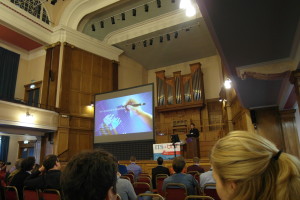
SAM_3375

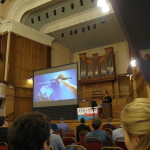
Jeff Han at ITS 2013

The conference was quite diverse, I was amazed by what kind of crazy ideas do people get. This also got me thinking that the ITS community is quite open-minded (something that I cannot say for most of the computer vision community, that I am observing more frequently). I have yet to empirically verify this observation by submitting a paper, as the acceptance rate is quite low. I will only mention some ideas that really got me interested:

  • Using a knife and fork analogy for two finger gestures
  • A HTML5 development framework for multi-touch surfaces
  • Perceptual grouping and selection of elements
  • Combining surfaces with NFC communication
  • Investigating piano accords to design multi-touch menus
  • Textile displays
  • Latency estimation for interactive displays

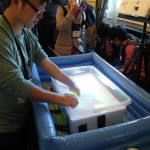
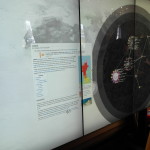
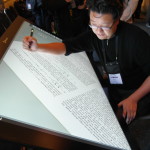
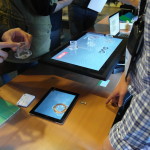
The demo session had more than a dozen different technologies, from prototypes to devices that you can (in theory at least) actually buy. The second generation of Microsoft PixelSense was cool, as well as a three-display Multitaction setup by MultiTouch Ltd. from Finland. There were also some other more wacky ideas, like a water-based display that I do not see beyond a very wet prototype, however, they show (in my opinion at least) the openness of the community. Anyway, here are some photos.